How Do You Drive AI Adoption In Your Team?
 Written by Akhil Raj Gupta
I was talking to a client recently, standing outside their office, overlooking a team of at least 100 people. This is a fast-growing startup and my client is the CEO. He’s also extremely AI-forward himself: ultra savvy with Claude Cowork, has multiple custom skills across various tasks, and builds dashboards for fun.
The problem is - he’s the only one. In the entire company.
“Everyone has their own standards for using AI. We don’t have a system that cuts across the entire company and we don’t know how to train or spot AI native talent. We know we need it, but we just don’t know where to start,” he said, and shrugged.
That statement stuck with me. Both because of how many times I’ve heard it before, and how a certain attitude of helplessness has become the default for leaders trying to drive wholesale AI adoption inside a company.
To be clear, this isn’t always the case. There are many startups and large enterprises that have driven significant changes in how their teams work across the board, and have seen great results from it. The frontier labs (OpenAI, Anthropic) themselves are exemplary, and they often share case studies on how their teams work with agents. Others that come to mind include Ramp, Notion, Uber, and Doordash.
At Airbnb too, I led multiple sessions to teach teams how to leverage AI for their work, and while it was a jagged line with slow progress, we eventually saw significant improvements.
Along the way, I’ve noticed a few underlying principles that I believe can benefit most people who find themselves in a similar situation -
1. Set An Example, And A Standard
AI is a very unique technology in the sense that almost anyone can become exceptionally good at it. All you really need is a logical mind, the willingness to push through the initial discomfort, and a certain baseline articulative ability. As such, great leaders are actually the ideal persona to be AI users, because they over-index heavily on all of the above.
I wanted to test this for myself, so I ran some analytics on my own Claude Code usage -
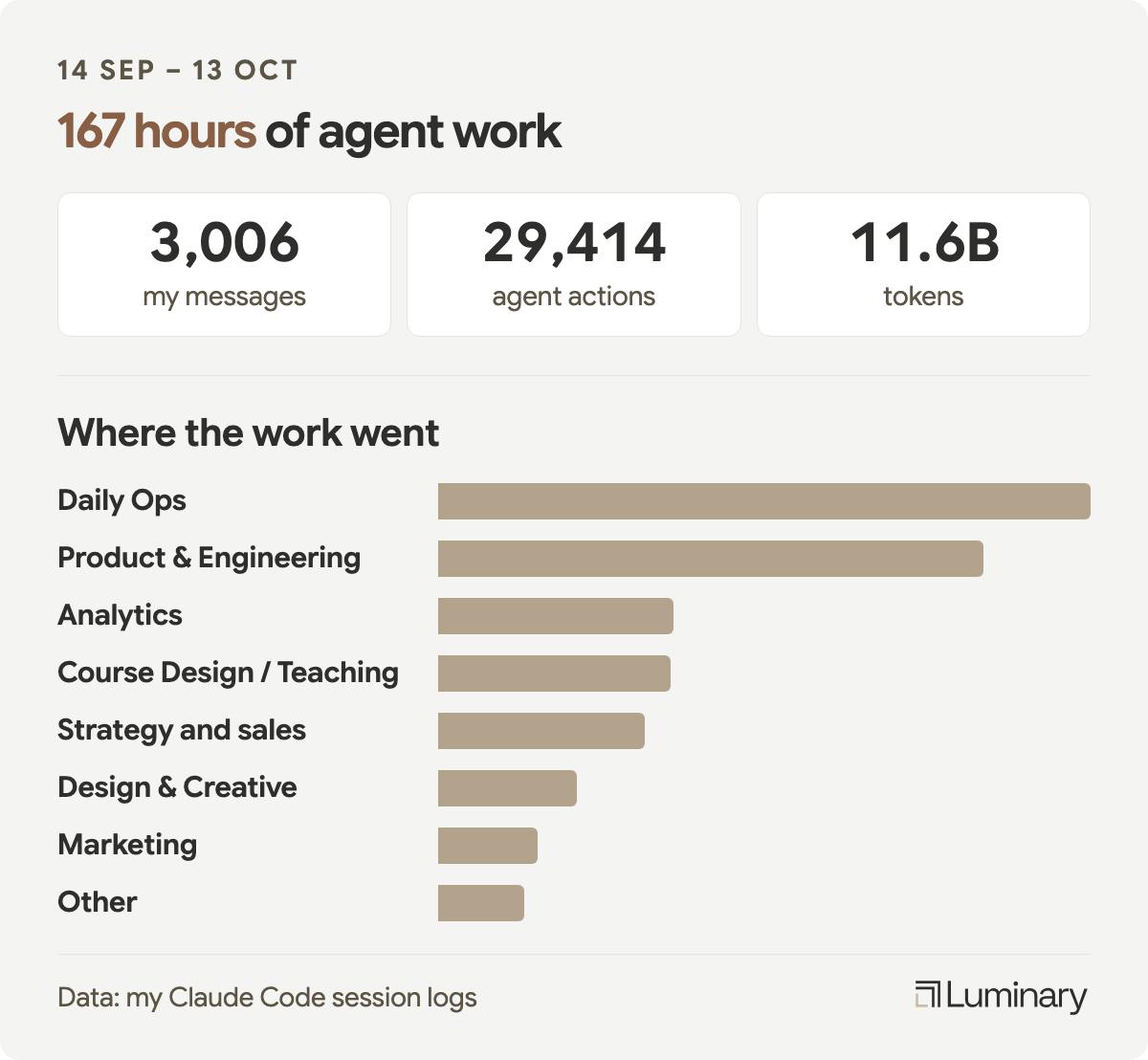
These aren’t necessarily the best metrics on their own (they are input only), but I’m clearly a visibly heavy AI user and my outputs also reflect that (I run a tech company with only 2 humans on staff).
As we grow the company further though, I won’t ever count myself out of the AI proficiency leaderboard. And I think more leaders need to set this sort of example themselves. If you need help with that, check out our Agents For Superproductivity course.
2. Teams Look Like Barbells
A June 2026 report from Section found that two thirds of knowledge workers use AI every week, but only 5.5% are actually proficient. Most (73.5%) use it for one-off tasks like looking things up, and another 20.9% barely touch it.
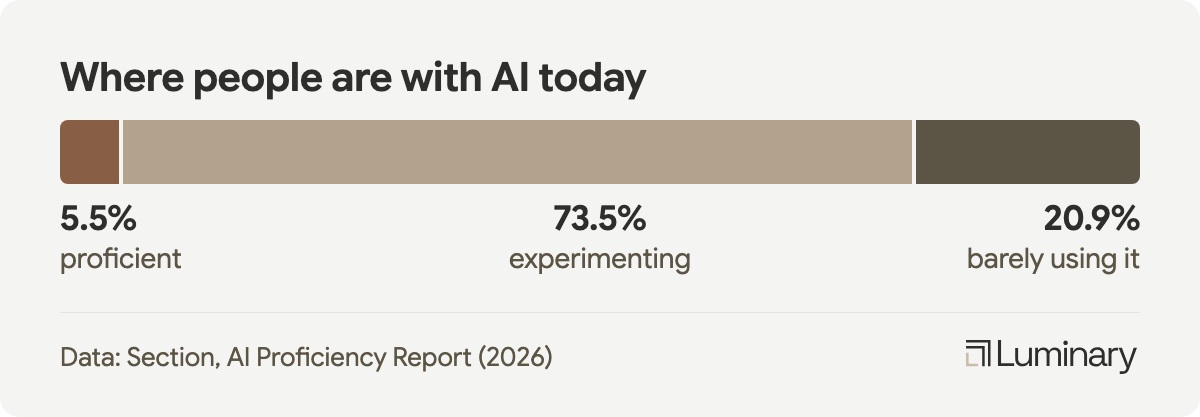
Here’s the good news - people who get good at AI keep compounding, because every workflow they build makes the next one easier.
The problem is, the rest stay exactly where they are.
And so, a single training programme for everyone is the wrong answer to a barbell. Your power users are past the intro session. Give them the room to build and a way to share what works. The people who haven’t started will learn more from a colleague showing them one useful thing than from a slide deck (in a BCG survey, 69% of employees put learning from colleagues among their top three ways to pick up AI). Treat them as two different problems.
3. Map Where You Are Today, And Measure What Matters
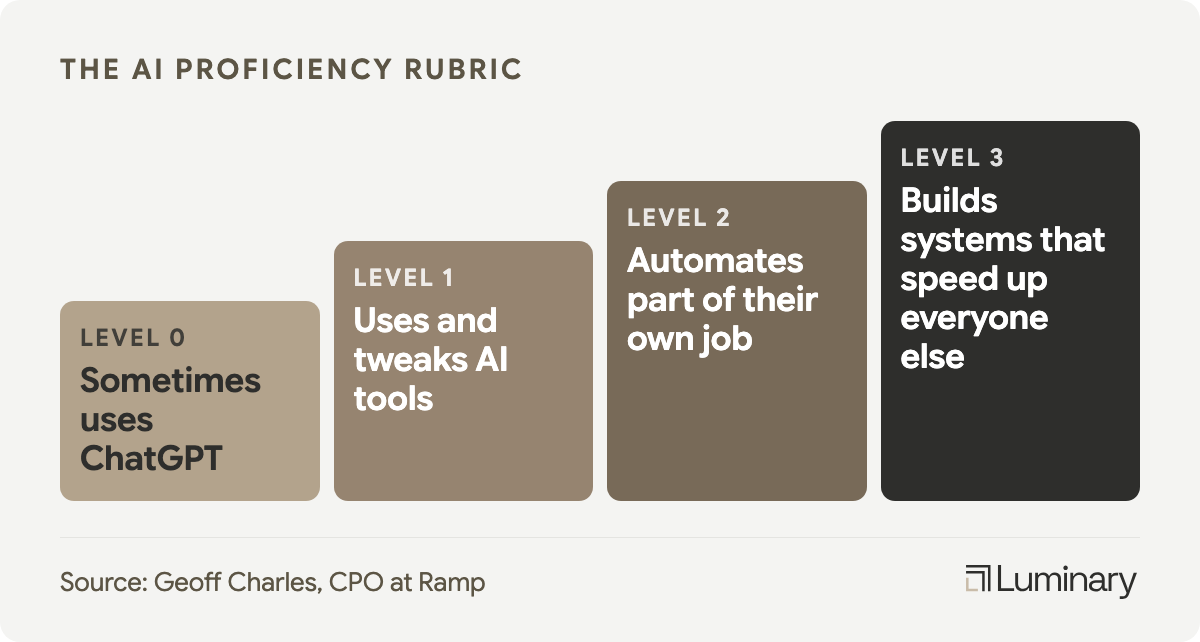
Every journey has a starting point. You must know yours. From a people lens only, the AI proficiency rubric is a good starting point. You should try and place as many of your people as possible (or ask each manager to do it) in at least one of the 4 levels.
Success metrics are a large topic unto themselves (we’re working on an essay). Token leaderboards obviously don’t work, because they are disconnected from outcomes. Generally speaking, you want to institute domain specific measurements that tie to the KPIs you most care about. For sales, it could be number of deals closed and leads acquired; for HR, something like employee satisfaction, churn rate, time to hire, etc.
Well-instrumented metrics also act as a natural safeguard against using AI for the sake of it.
Token leaderboards obviously don’t work, because they are disconnected from outcomes.
4. Phase Out The Non-Believers And Start Hiring (Very) Differently
We love humans at Luminary. But not if they don’t share our vision on the future of work.
We frequently advise our clients that they need to identify these non-believers and figure out the root cause. Much of it is coachable, but there will always be people who resist change regardless of what you do. They are also often quite vocal about it. As a leader, you need to make a hard call on whether some passengers need to get off your bus.
As a leader, you need to make a hard call on whether some passengers need to get off your bus.
You also want to actively scout for AI-forward talent in future hiring. I would typically look for this in two ways - firstly, does the person have a ready portfolio of projects that they’ve tinkered with on the side.
The second is how you interview them.
I don’t believe in putting people on the spot and making them use AI products live “just to see how they prompt”. Instead, do a take-home case study round, and demand unreasonable outcomes (a website mockup, a dashboard, a statistical model).
Actively encourage use of AI tools (they’re going to be part of the job anyway) and if you want, ask for the session transcript. You can glean so much from a process like that, not only about how well a person leverages AI capabilities but also how much of the core thinking do they retain themselves.
5. The Rule Of One
You’re not going to solve this overnight. Adoption is in many ways a much bigger challenge than deployment. Start small - upskill yourself, then adopt the Rule Of One.
Pick one team and identify one AI champion. Take an easy agent-shaped workflow (like automation of competitor research or screening candidates on obvious dimensions) and test a few approaches.
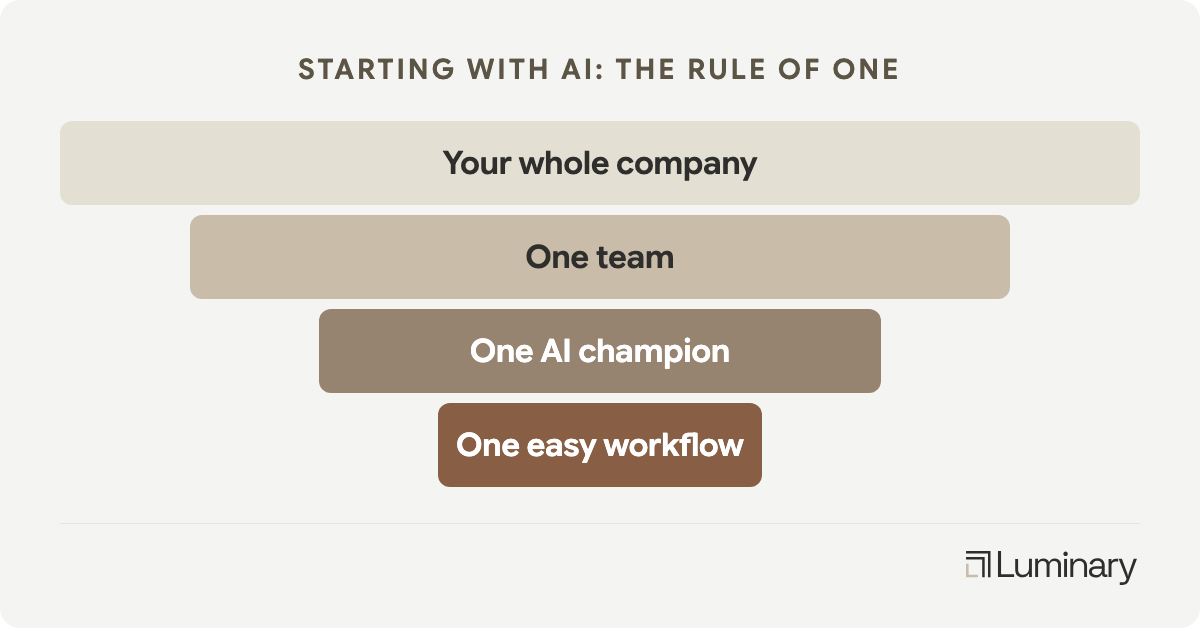
Then repeat the process.
I hope this helps.
Akhil